Chapter 2: Identify, Assess and Control Security Hazards and Risks

Key Objectives
- Identify hazards in the work area and assess security risks.
- Report hazards and risks immediately to relevant persons following workplace procedures.
- Use the hierarchy of control to select and apply appropriate methods to control the hazard or minimise risk as far as possible within limits of own authority.
2.1 Identify hazards in the work area and assess security risks.
- Hazard identification is a method for determining whether a given situation, item, or thing has the potential to cause harm.
- Hazard identification aims to locate and record potential hazards in your workplace.
- It may be beneficial to work as a team that includes people familiar with the work area and those not—this way, you will have both an experienced and a fresh eye to conduct the inspection.
Identifying hazards in the work area:
- Continuous monitoring of the work environment.
- Debrief and review of security incidents.
- Regular informal and formal discussions with colleagues.
- Regular inspections of equipment and work area.
- Review of workplace health and safety records.
2.2 Report hazards and risks immediately to relevant persons following workplace procedures.
- Risk assessment is one of the most important safety processes a facility must perform.
- These assessments can help you identify potential issues and make the necessary changes to avoid hazards.
- While these assessments are important, they are imperfect, which is why workplace accidents and injuries occur.
Typical workplace hazards can be:
- Breaches of law e.g. criminal damage, offences against people, public order, misuse of drugs and alcohol.
- Emergencies e.g. fire, scenes of crime, accidents.
- Hazards e.g. physical, chemical, electrical, psychological, biological.
- Threats e.g. bombs, sabotage, assassination.
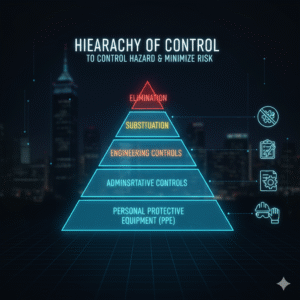
2.3 Use the hierarchy of control to select and apply appropriate methods to control the hazard or minimise risk as far as possible within the limits of own authority.
- Risk management identifies and eliminates internal risks to an organisation that could disrupt operations.
- Risk management aims to protect all assets, including business employees, equipment, and other assets.
- Security service providers assist clients in conducting physical security assessments and developing custom solutions.
How to apply the hierarchy of control to control hazards and minimise risk:
- Eliminate the risk.
- The risk can be reduced by using engineering controls, isolation, or substitution.
- Reducing the risk using administrative controls.
- Reducing the risk of using personal protective equipment (PPE).
error: Content is protected !!
Get a Free Quote