Introduction and Core Principle
- Security workers may convince clients and stakeholders to take security seriously through effective communication skills.
- Gentle persuasion strategies can help you convince resistant clients to sign up for more robust security measures.
- By creating and putting into place efficient rules and procedures, security is the concept of providing protection, defence, safety, and confidence.
- To deter crimes and make it easier to identify those who conduct them, business security involves setting minimum criteria for installing and using all security plans, equipment, and procedures.
- The Security Program outlines the policies and procedures for establishing and upholding a secure working environment.
- A security guard bears enormous obligations because many people’s lives are in their hands.
- Assure the public that the laws governing security officers comply with public health and safety standards.
- To encourage and foster the greatest standards of effectiveness, service, equipment, and moral behaviour among those in the security profession tasked with protecting someone else’s property.
Chapter 1: Confirm and Comply with Legal and Procedural Requirements and Professional Standards

- A security guard’s duties and obligations do not stop guarding, monitoring, patrolling, and reporting to authorities in the event of any criminal behaviour.
- In some cases, they may be expected to run errands, answer their boss’s text messages and phone calls, and take on extra obligations.
- Understanding the tasks and responsibilities of unarmed security guards will help us work more effectively with them.
- Making sure your property is secure begins with understanding all of the duties of a security guard.
Legal and Procedural Framework
The legal and procedural framework for performing security work includes:
- Anti-discrimination.
- Apprehension, arrest and restraint of persons.
- Duty of care.
- Licensing requirements and limits of own authority.
- Privacy and confidentiality of information.
- Records and reports that may be used for legal purposes.
Standard Operating Procedures (SOPs)
- The capacity to outline the actions and procedures necessary to carry out a certain task is made possible by standard operating procedures (SOP).
- A standard operating procedure is a written description of the routine tasks important to the accuracy of the investigation.
General security-related policies and procedures include:
- Access control policies and procedures.
- Arresting policies and procedures.
- Procedures for approaching a Person of Interest.
- Code of conduct.
- Code of ethics.
- Complaints process.
- Documentation and record keeping.
Professional Standards and Ethics
- As a guiding concept, security officers must always behave responsibly and professionally in all facets of their jobs.
- If a security officer is determined to have violated the provisions mentioned in this Part, they may face disciplinary action.
- Every reputable private security firm gives its security guards a distinct written code of ethics to govern their performance and approach to their responsibilities.
- Every security business has its persona and culture, which they infuse into its code of ethics; nonetheless, the Task Force on Private Security’s principles and aims are frequently utilised as the fundamental model.
- It is the primary obligation of every security officer to serve the interests of their employers.
- It is every security officer’s essential duty to serve the interests of their employers’ clients.
- Every security officer should be truthful in their thoughts and actions, whether personal or official.
- Every security professional must follow the laws of the land and the rules established by their employers.
Security Officer Duties and Work Environment
Primary Roles and Duties
- While security guard duties and responsibilities vary based on the client’s needs, the primary role of security professionals is crime prevention and deterrent, as well as upholding the rules and regulations of the area they are protecting.
- A security guard’s duties could be as simple as being present to responding to robberies and assaults and maintaining law and order.
- Security guards maintain crowd control while guarding persons, property, and other items.
- They patrol private and public areas looking for unauthorised entrance or anyone acting in a harmful, illegal, or otherwise prohibited way.
Key Responsibilities
- Setting up security controls and systems.
- Regularly inspecting and patrolling the property.
- Watching security cameras and reporting strange behaviour.
- Interacting with emergency medical workers, fire departments, and law enforcement.
- Controlling public access and guaranteeing the safety of all employees and guests.
General Duties Summary:
- Observe and Report.
- Be Visible.
- Maintain Order.
- Help Guests.
- Protect the Property.
Working Conditions and Equipment
- Shift work is typically the norm for security officers, including nights, weekends, and holidays.
- While some security officers spend each shift at a single location, others rotate between several sites.
- Security guards typically spend a lot of time moving around as they patrol the area where they are posted.
- Most security professionals use radios and cell phones to stay in touch with a partner or the main office in case backup is required.
- They also employ closed-circuit television (CCTV) and electronic alarm systems to help monitor the area and spot potential issues.
- Additionally, security officers who patrol multiple locations must travel between them by driving, frequently in vehicles with spotlights.
Security Study Assessment Topics
The security study will assess and provide advice about:
- Procedural Security.
- Information Security.
- Technical Security.
- Physical Security.
- Security Guards.
Security Work Nature and Risk
- Due to its nature, security work is unpredictable and dangerous.
- Depending on the risk rating, the hazard in the various sorts of missions performed by security personnel increased.
- These will differ depending on the work or assignment assigned to the Security Officer.
- Examples provided: Communication center security personnel, The officer of static security, The officer of static security at a bank.
Communication and Information Handling
1.2 Use listening and observation skills
- 1.2 Use listening and observation skills to receive and interpret spoken and non-verbal information.
- Information may be from sources which are: Diagrammatic, Electronic, Numerical or statistical, Observed, Spoken.
- Information may relate to: Work tasks, Clients, Colleagues, Members of the public, Messages, Reports, Risks, hazards, or incidents.
Five Senses for Duty
- Eye=Sight: Visual perception is used to detect unusual activities.
- Ear=Hearing: Determine the abnormal sound in the surrounding area.
- Nose=Smell: Environmental fragrance can be used to detect unusual occurrences.
- Skin=Touch: Touch the surfaces, packages, and people to identify hazards and risks.
- Tongue=Taste: This method should only be used to detect security issues.
1.3 Use oral and non-verbal communication
- 1.3 Use oral and non-verbal communication to develop and maintain positive relationships, mutual trust, and confidence.
- Security incidents can occur at any time and in a variety of ways.
- The first step in keeping you safe is being ready by employing security personnel and determining your security needs with a reputable security officer company.
- Ways to read and use non-verbal communication: Listen, Communicate, Offer solutions.
1.4 Clarify understanding
- 1.4 Clarify understanding of received information with relevant persons using clear and concise language, questioning and summarising.
- A security officer must be able to converse with individuals of many backgrounds, cultures, and tongues because they are the first to respond to customers, vendors, and public members when performing their duties as security employees.
- You must practice and learn effective communication skills to carry out your duty.
- Communication Types: Verbal, Non-verbal, Visual, Written.
- Strategies used for clarification are: Face-to-face interaction, Make eye contact when clarifying, Listen and pay serious attention to what the other person is saying, Speak clearly and quietly, Pay attention to nonverbal cues from others.
Relevant Persons
Relevant person(s) may include:
- Clients (including young people).
- Colleagues.
- Members of the public.
- Specialist personnel.
- Supervisor.
- Suppliers of equipment or products.
- Legal representatives.
- Management.
- Technical experts.
- Workplace trainer or mentor.
Evidence and Scene Management
Evidence Handling Responsibility
- The police officers have the responsibility to handle and process evidence.
- But, there are certain occasions when safety officers may need to handle the evidence.
- It is essential for safety officers to implement the correct process and procedure of handing evidence.
- This will help to secure the crucial evidence and manage the incident and crime scenes before the arrival of the police.
Principles of Incident Scene Management
- Prevention of scene contamination.
- Prevention of evidence destruction.
- Prevention of evidence movement.
- Prevention of evidence removal.
Evidence Handling Procedure
- Collection.
- Securing.
- Preservation.
- Identification.
- Continuity of custody.
- Logging.
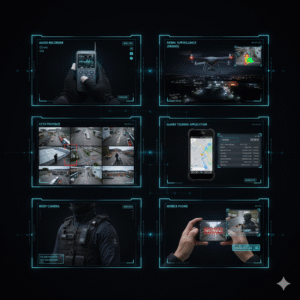
Evident Recording Technology
- Audio recorders.
- CCTV footage.
- Guard touring applications (mobile).
- Aerial surveillance (drones).
- Body cameras.
- Mobile phones.
Policy and Leadership
- Only as good as your most recent yearly security assessment or survey will your security policy, and procedures manual be.
- Your security director and the proper corporate officers in each function and the department will need to delegate responsibility for implementing the firm’s security program following each reassessment.
- Your security team may be under the direction of the security director.